FIGHTING TO PROTECT RESEARCH FUNDING
UPDATE:
The federal budget proposals for fiscal year 2026 initially called for devastating cuts to agencies including the National Science Foundation and the National Institutes of Health. However, after a concerted effort which included lobbying and organizing by tens of thousands of UAW members, Congress rejected many of the most severe reductions and instead funded agencies at levels closer to prior years. Attempts to slash NIH funding were also blocked by the courts. While we're relieved, there's still more work to be done. Policy changes such as the multi-year funding models will have negative impacts on our labs and universities. We must continue to push for a better way to do science funding.
NIH
From January through the summer, NIH funding for new grants dipped dramatically as compared to 2024. Following the coordinated efforts by thousands of academic workers across the country through the Kill the Cuts campaign, NIH grant approvals surged in August and September such that the NIH spent its entire budget for Fiscal Year 2025. The Kill the Cuts campaign included rallies across the country, phonebanks, Town Halls with members of Congress, petitions, sign-on letters and much more.
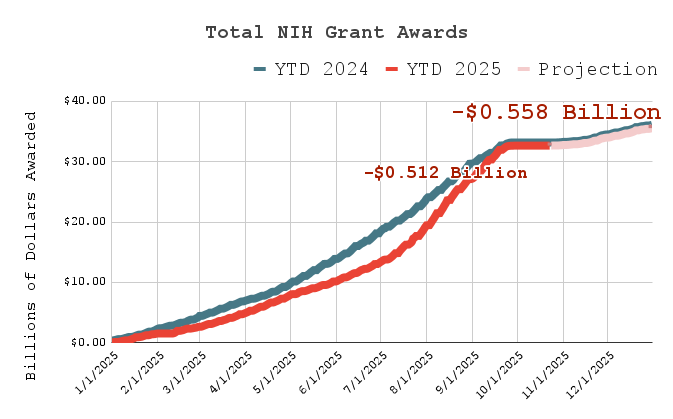
Despite spending all their 2025 funds, the total number of approved grants has significantly decreased due to changes mandated by the Trump administration as to how approved funding is distributed in future years. This change will drive grant application approval rates even lower, meaning that the very difficult process to receive an NIH grant approval will get even harder. This will also disproportionately impact early-career researchers who are trying to get their labs and research programs started. In the 2026 Senate budget bill, Senate appropriators have directed the NIH to return to the previous model of funding distribution to prevent this drop in grant approval rates.
NSF
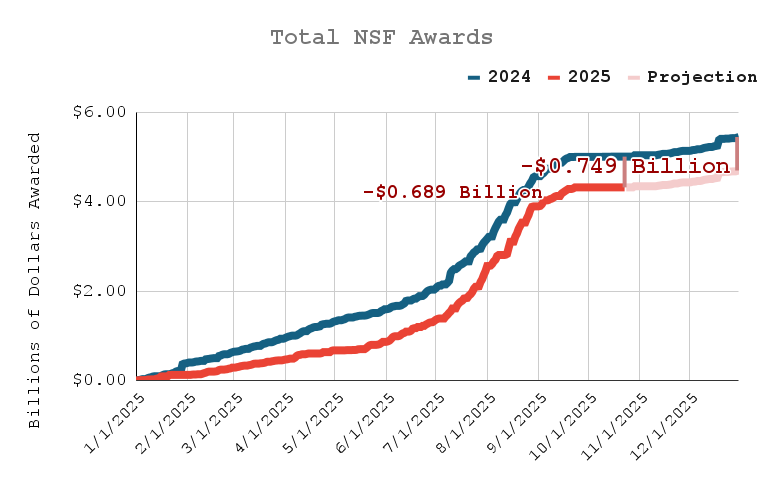
Funding available for the approval of new NSF grants in Fiscal Year 2025 decreased by approximately $750 million compared to 2024. This reduction was driven primarily by freezes and delays in the grant review and approval pipeline, which slowed the pace at which proposals could be evaluated and awarded.
As a result, early-career scientists and researchers running ongoing projects may face increased challenges securing funding for their laboratories and programs.
USDA
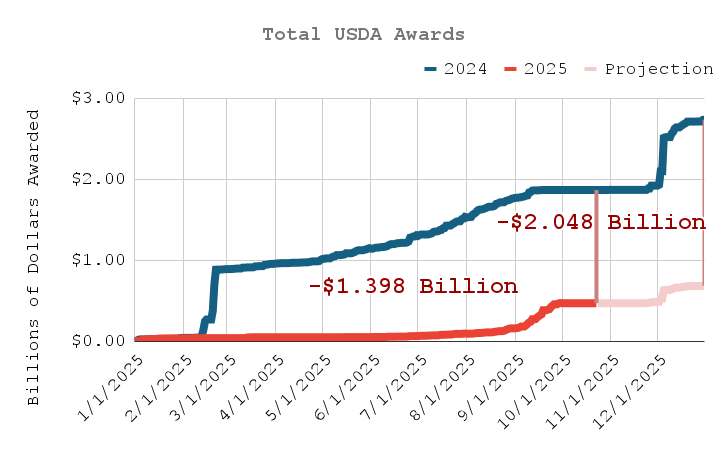
New research grant approvals through the National Institute of Food and Agriculture have dramatically decreased in Fiscal Year 2025 compared to 2024. This reduction is primarily the result of freezes and delays in the grant review and approval process.
DOE
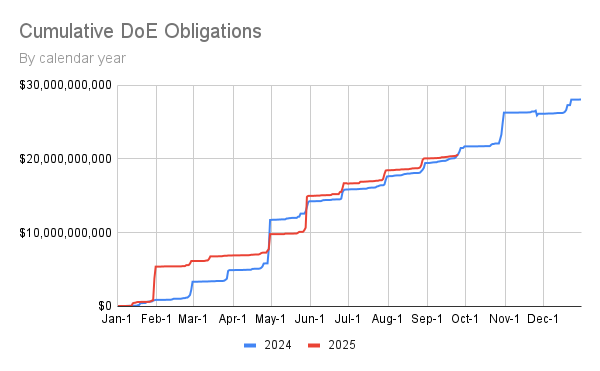
Funding from the Department of Energy (DOE) to universities has decreased by over $1 billion in Fiscal Year 2025 compared to 2024. DOE project cancellations have halted at least 150 active projects that had been awarded to 73 universities and colleges nationwide. Only 16% of the original awards have been allocated as intended. This reduction affects basic science, applied energy research, and laboratory programs.
NOAA
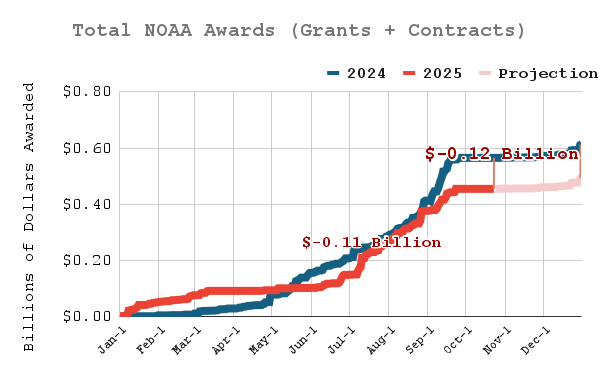
Funding for new research and programs at the National Oceanic and Atmospheric Administration (NOAA) has been reduced in Fiscal Year 2025 due to budget cuts, freezes, and delays in project approvals. These reductions affect both research grants and operational programs across climate science, oceanography, and atmospheric studies.
Reduced support may slow progress on critical climate and ocean science projects that inform policy and public safety.
NASA
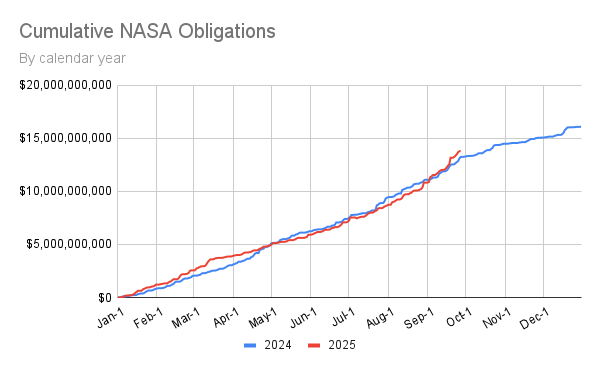
The Trump administration proposed substantial cuts and project cancellations in the Fiscal Year (FY) 2026 budget. Some NASA centers, including the Jet Propulsion Laboratory, laid off workers even before a budget was approved by Congress.
Workers organizing with UAW participated in rallies, lobbying, and town halls with elected representatives to advocate for NASA funding. Ultimately, Congress rejected the proposed cuts, although the Mars Sample Return project was cancelled. Researchers and staff at NASA-funded projects still face uncertainty about funding and job stability as Congress looks ahead to FY 2027, which could affect ongoing missions, early-career researchers, and new research initiatives.
https://www.astronomy.com/science/nasas-jpl-lays-off-550-employees/
https://www.planetary.org/articles/advocacy-success-fy2026-nasa-budget
NEH/NEA
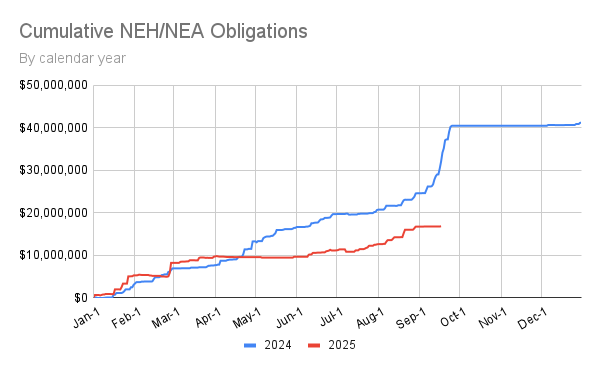
Grant funding from the NEH and NEA decreased by approximately $23 million in Fiscal Year 2025 compared to 2024, following cuts to hundreds of grants. Many early-career researchers, artists, and organizations relying on federal support may face increased difficulty securing funding for projects, programs, and initiatives.